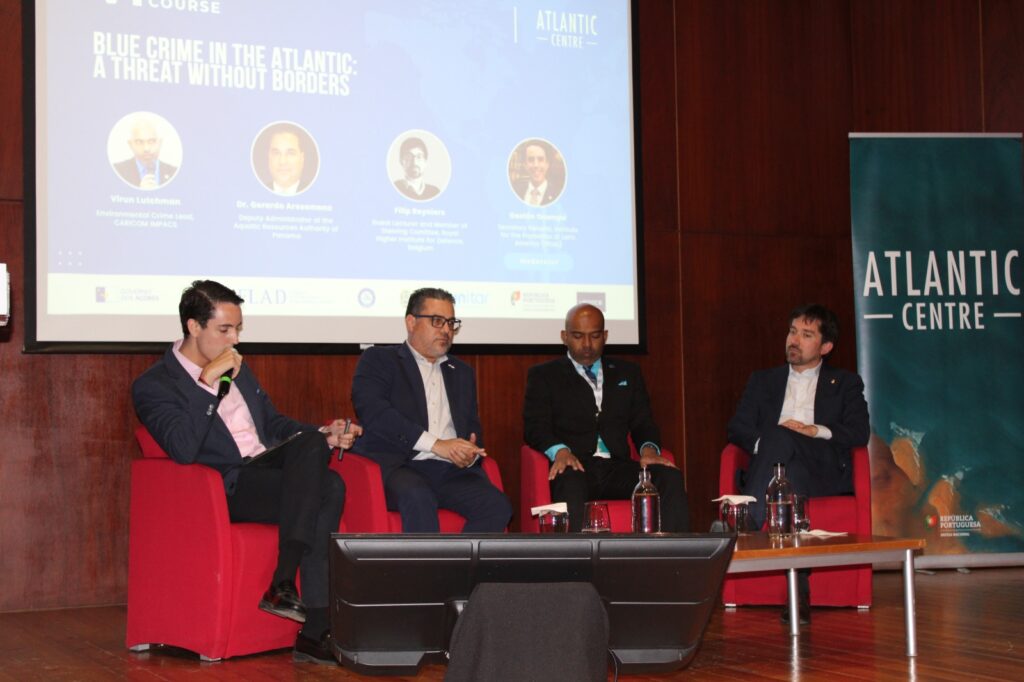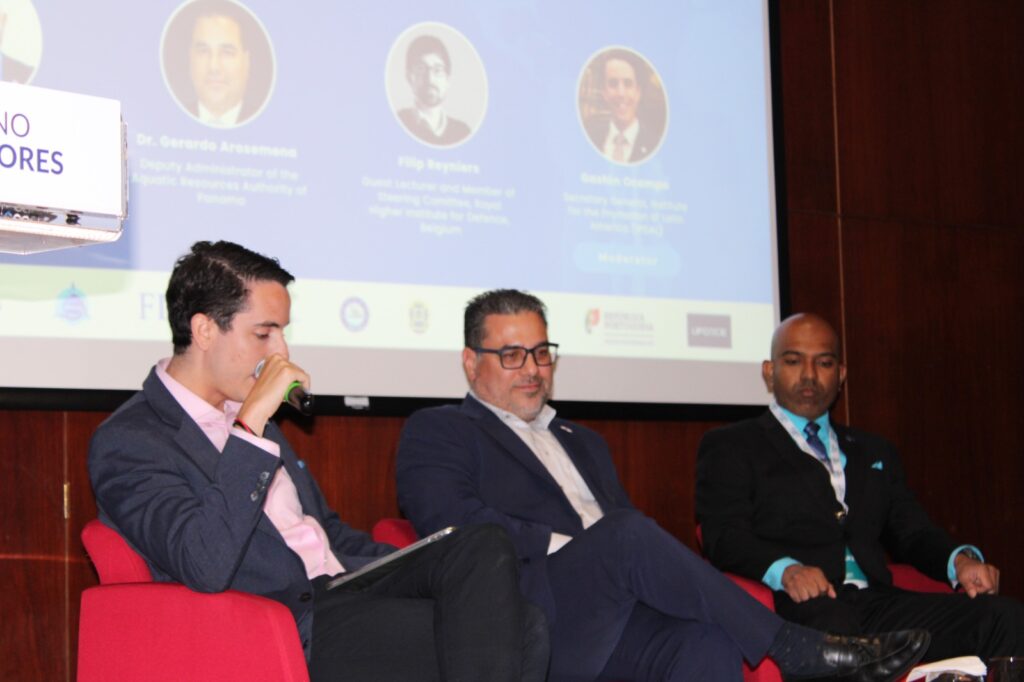


IPDAL Secretary-General, Gastón Ocampo, participated in the VI Maritime Security Course, organized by the Atlantic Centre and held in Ponta Delgada, Azores, where he moderated the panel “Environmental Crime, Fisheries and Critical Infrastructure.” The session brought together international experts to discuss the growing challenges posed by maritime environmental crime, illegal fishing, and the protection of critical infrastructure.
In his opening remarks, Gastón Ocampo highlighted the global scale of environmental crime, currently one of the world’s most profitable illicit economies, and warned about the impact of Illegal, Unreported and Unregulated (IUU) Fishing on food security, economic stability, and the sovereignty of coastal states.
The discussion was based on the premise that environmental crime at sea is no longer solely an ecological issue but has become a multidimensional security challenge, linked to transnational organized crime, weaknesses in maritime governance, the vulnerability of critical infrastructure, and increasing geopolitical competition.
The panel featured Virun Lutchman, Environmental and Maritime Crime Analyst at CARICOM IMPACS, Gerardo Arosemena, Deputy Administrator of the Aquatic Resources Authority of Panama, and Filip Reyniers, member of the Steering Committee of the Royal Higher Institute for Defence of Belgium.
Among the topics discussed were the expansion of criminal activities in the Caribbean through the exploitation of maritime surveillance limitations, the links between illegal fishing, drug trafficking, and human trafficking, the challenges faced by Panama as a strategic hub for global maritime routes, and the protection of critical maritime infrastructure in an increasingly complex international environment.
The discussion also emphasized the importance of strengthening international cooperation, information sharing, and coordination among states and regional organizations to address threats that transcend borders and challenge traditional enforcement mechanisms. In this context, the role of the Atlantic Centre as a platform for dialogue, cooperation, and knowledge-sharing among Atlantic countries was highlighted, fostering joint approaches to emerging maritime security challenges.
The panel concluded that protecting the oceans and maritime resources requires an integrated approach that combines deterrence capabilities, institutional resilience, and international cooperation—elements that are increasingly essential to ensuring maritime security in the Atlantic and other strategic regions.